Ask an aluminium dealer what a section costs and you will not get a price per piece. You will get a number per running foot, quoted as a percentage off something called the circular.
Both of those are completely standard in the trade and almost nobody explains them. If you are buying — building a house, running a fabrication workshop, pricing a job for a client — understanding them is the difference between comparing two quotes properly and guessing.
Running feet is total length, not pieces
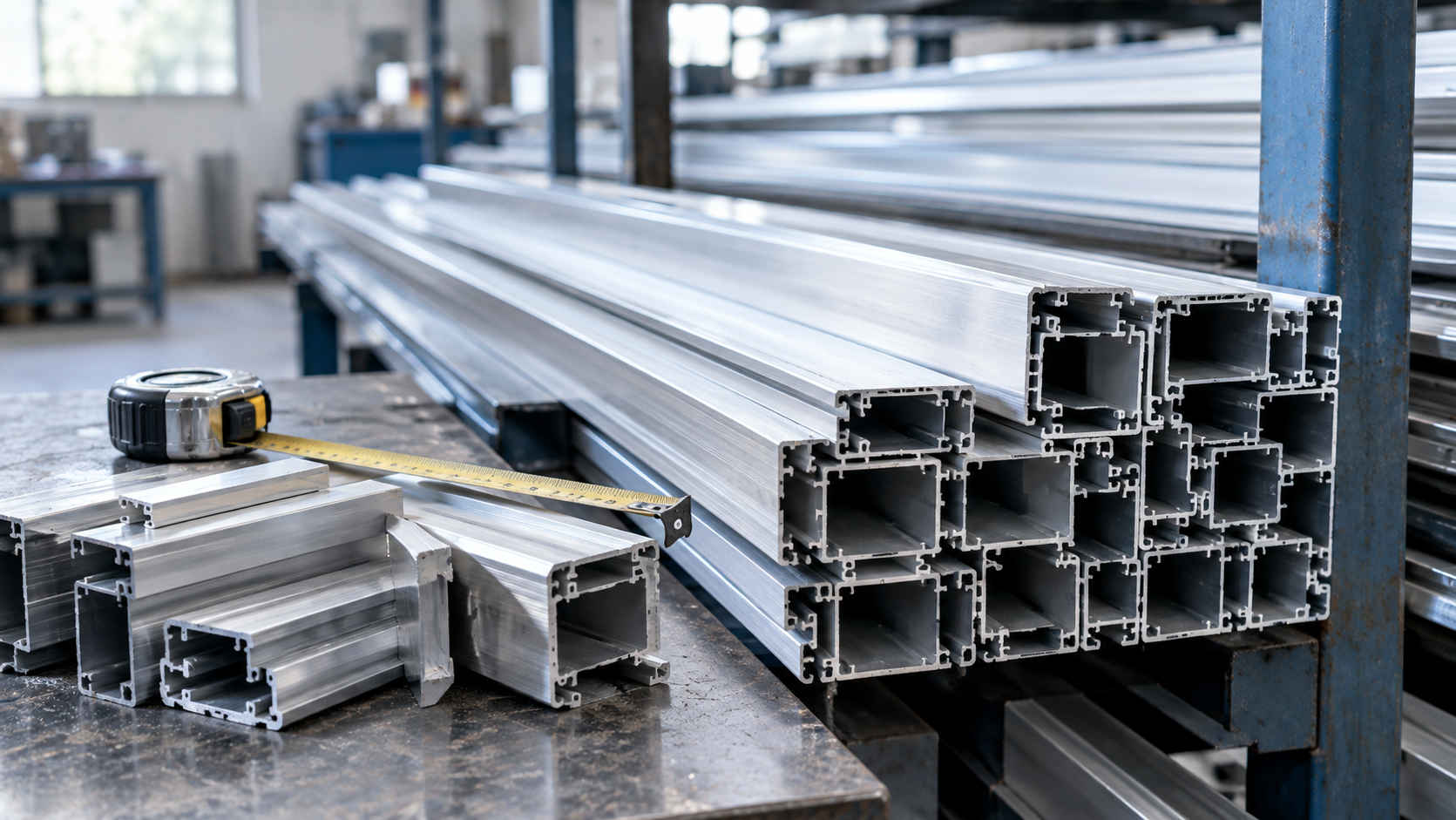
Aluminium section comes in long lengths. You do not buy "six pieces", you buy the total footage those pieces add up to.
So if you take 6 pieces of 12 ft, that is 72 running feet. At Rs 180 per running foot the material is Rs 12,960 — and the same 72 ft would cost the same whether it arrived as six 12 ft lengths or four 18 ft ones.
Why it is sold this way is simple: the mill extrudes section in lengths and prices it by weight, which for a given profile is proportional to length. Feet is just the unit everyone can measure at the counter.
What this means in practice is that the number of pieces still matters to you, even though you are paying by the foot. If your window needs a 7 ft upright, you cannot make it from an offcut of 5 ft, no matter how many running feet you have bought. Tell the dealer the lengths you need, not just the total.
The circular, and the percentage off it
Manufacturers issue a printed rate list — the circular — giving a list rate for each section, colour and thickness. It changes when metal prices move, sometimes more than once in a season.
Dealers do not sell at the circular. They sell at the circular less a percentage, and that percentage is the actual negotiation. A shop quoting "circular minus 12" and a shop quoting "circular minus 18" are selling the same metal at genuinely different prices.
This is why two quotes for the same window can differ and both be honest. One dealer has a better margin, or a bigger order behind him, or is simply hungrier that week.
So the question to ask is not "what is your rate?" — it is "which circular, and what percentage off?" A dealer who can answer both immediately is one who knows his own costs. One who cannot may be quoting from memory, and memory in a market where rates move is how a shop loses money without noticing.
Thickness and colour change the rate, and that is not a trick
The same section in a heavier thickness is a different line on the circular, because it is genuinely more metal. Powder coating and anodising sit on top of that again, and the darker and more specialised the finish, the bigger the difference.
When you compare two quotes, check you are comparing the same section, the same thickness and the same finish. A quote that looks ten percent cheaper is often a lighter gauge, which you will notice the first windy season.
The offcut is worth money — yours or his
Here is the part that is usually invisible on a bill.
A dealer takes a 22 ft length and cuts you 15 ft. The remaining 7 ft does not disappear. It is still aluminium, it is still sellable, and in a well-run shop it goes back on the rack as a short length for the next customer who needs exactly that.
In a badly run shop it leans in the corner until nobody remembers what section it is, and eventually it is sold as scrap. That loss has to be recovered from somewhere, and it is recovered from the rate you are quoted.
Which is why it is always worth asking whether the dealer has a suitable offcut. If he does, and he knows he does, you can often get a short length at a better price than a fresh cut — it suits you both. Exactly like working out tile boxes before you buy, the saving is not in haggling. It is in knowing what the material actually costs to supply.
If you run the shop rather than buy from it
Everything above is a dealer's daily arithmetic: convert pieces and lengths to running feet, apply today's circular less your own percentage, and keep track of what is left on the rack.
Aluminium Plus does it at the counter. Enter the pieces and their length and it bills the running feet. Hold the circular rate against each section, set your own percentage — per section, per colour, per thickness — and the bill prints both the list rate and the discount, so the customer can see what he was given instead of being told. Cut 15 ft off a 22 ft length and the 7 ft offcut stays on your stock as a sellable short, not as scrap in the corner. Whole-job estimates convert straight into a bill without re-entering anything.
It runs offline on one computer, one-time price, with a free 15-day trial.