The udhaar khata: how to keep one that actually gets paid
Nobody loses money on udhaar in one go. It goes missing in small pieces — a date nobody wrote, a part payment in the margin, a page copied into a new register.
Nobody loses money on udhaar in one go. It goes missing in small pieces — a date nobody wrote, a part payment in the margin, a page copied into a new register.
Every shop in Pakistan runs on udhaar, and every shopkeeper has the same register: a thick notebook, a name at the top of the page, figures down the side, and somewhere in the margin a number that was written in a hurry.
Nobody loses money on udhaar in one go. It goes missing in small pieces — a date nobody wrote, a part payment squeezed into the margin, a page copied over when the old register filled up. By the time there is an argument, both of you are sure, and neither of you can prove it.
A register is a list of numbers. What you actually need is a list of events: he bought, he paid something, he bought again, he paid the rest.
When you only keep the running total, every one of those events disappears into a single figure. Then the customer says "bhai, maine pichlay hafte paanch hazaar diye thay" — and he may well be right. The payment happened. It just never got written as a payment; it got subtracted from a balance and the old figure crossed out.
Whether you keep it on paper or on a computer, write these four. Miss any one and the entry is worth less than the ink.
That last one is the single most useful habit on this page. A crossed-out number is an argument waiting to happen. A line that says "14 March — received Rs 5,000" is not.
Ask most shopkeepers what their stock is worth and they will tell you roughly. Ask what is outstanding in the khata — the total of everything owed to you, across every page — and there is usually a pause.
That number is your money. It is sitting outside your shop, in other people's houses. It is often larger than the cash in the drawer and sometimes larger than the stock on the shelf.
If you cannot say it within a few thousand rupees, you cannot plan a purchase, you cannot judge whether this month was good, and you cannot tell the difference between a slow month and a month where you simply gave a lot away on parchi. It is the same discipline as knowing how many boxes a job needs instead of guessing: the arithmetic is not hard, it is just never written down in a form you can add up.
A customer buys for Rs 12,000 and hands you Rs 5,000 at the counter. This is the most ordinary transaction in a Pakistani shop and it is the one registers handle worst.
What usually gets written is "7,000" — the remainder. The Rs 5,000 vanishes. Your day's cash does not match your day's sales, and nobody can explain the gap a week later.
Write both. A sale of 12,000, and a payment of 5,000 against it. The balance is then something the book calculates, not something you decided. Your cash reconciles, and the customer's own copy agrees with yours.
And if he pays more than he owes — it happens, especially with regular customers settling in round figures — that extra is not profit. It is his money that you are holding, and it should sit in his account as an advance against the next purchase.
Half of all khata arguments end the moment a customer is handed something printed with the date, the amount and the balance on it. Not because it proves anything in a court — because it means two people are looking at the same figures.
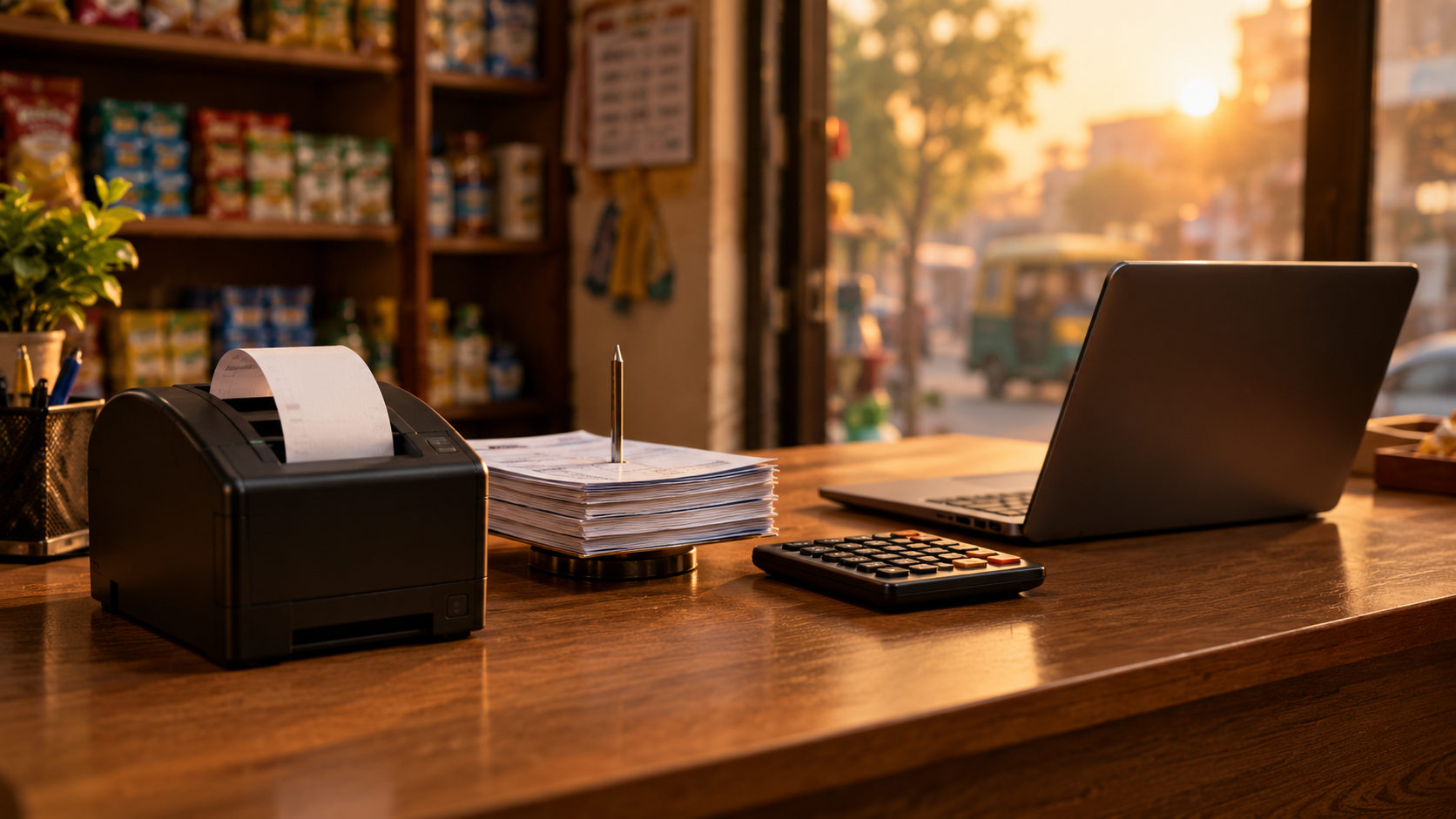
If you have a printer at the counter, print it. If you do not, send it on WhatsApp. A message with the date and the amount is a record both of you keep, and it costs nothing.
Paper works perfectly well up to a point. The point is usually one of these: the register is full and you are copying balances by hand, more than one person is writing in it, or you have stopped being able to answer "how much is out there?" without an afternoon of adding.
Every POSPlus system keeps the khata the way this article describes, because it is the way it has to be kept. A sale with cash at the counter is recorded as both — the sale and the payment — so the drawer and the book agree. The previous balance prints on the next bill, so the customer sees it before he asks. Every payment prints a voucher, or goes on WhatsApp. And the total outstanding is on the screen, not at the end of a long afternoon.
It runs offline on one computer at the counter, one-time price, with a free 15-day trial. But the habits above are worth adopting today, in the register you already have.